


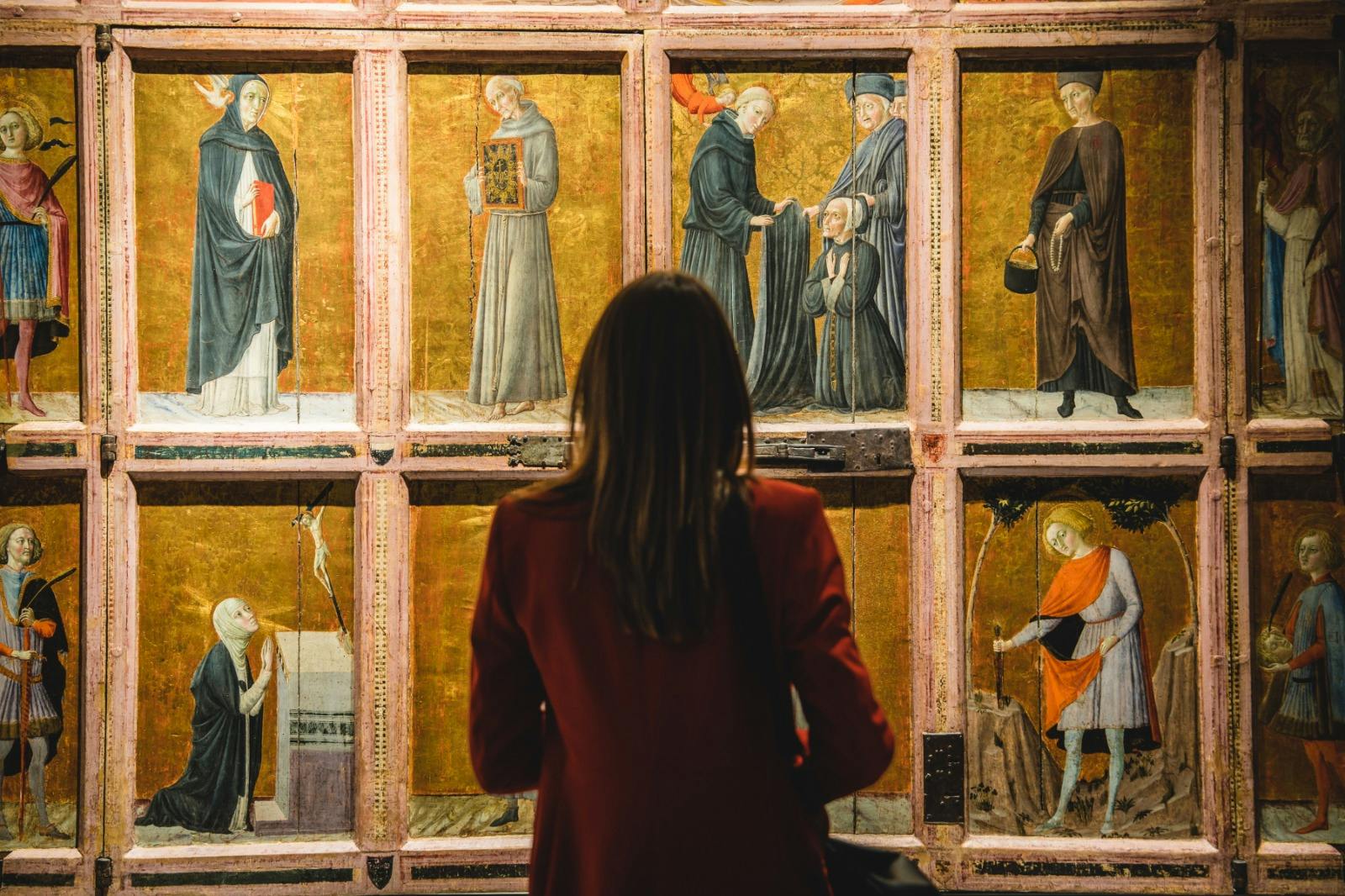


On the occasion of the exhibition "Remember Joseph Beuys", on 5 October the museum hosts an afternoon dedicated to the German artist, with a guided tour and a screening of the film "Lucrezia e Joseph Beuys" by director Pierdavide Tedeschi.
Where
When
From 8 March 2026 to 8 March 2026
On the occasion of International Women's Day, Sunday, March 8 all women will be able to visit the museum complex for free.
The museum will be open to the public from 10:00 AM to 7:00 PM.
Locations
Saint Ansano Hall
The Sant’Ansano hall, together with the adjacent San Galgano hall, originally constituted a single large space that served the function of a male pilgrims' dormitory.
Chapel of the Mantle
The Mantle Chapel of Santa Maria della Scala has been one of the most altered spaces over the course of its long history.
Internal road
The medieval hospital contains an extraordinary pathway for access to the various levels and connection between the parts: this is the so-called 'internal road' or covered road, which, in the memory of the Sienese of the twentieth century, is most often recalled as 'voltoni'.
San Pio Hall
From the 14th century the San Pio hall was part of another ‘pellegrinaio’ of the hospital that later became an infirmary.
The Stroll
On 17 August 1379 a resolution of the hospital recorded the existence of a pilgrims' hostel and ordered its duplication in an identical room.
Oratory of Saint Catherine of the Night
These evocative rooms, located in the heart of Santa Maria della Scala, where Saint Catherine of Siena paused in prayer and brought comfort to the sick, still preserve today the intensity and the atmosphere that for so many centuries has accompanied the religious fervor of the Saint's countless devotees. Known since the 14th century as the confraternity of Saint Michael the Archangel, the company was chiefly devoted to piety for the deceased.
Confraternity of the Madonna under the Vaults of the Hospital and the Society of Executors of Pious Dispositions
The Confraternity of the Disciplinati of the Most Holy Mary, later the Society of Executors of Pious Dispositions, is the oldest lay brotherhood located in the undergrounds of Santa Maria della Scala. Initially founded in the Cathedral of Siena, the existence of the confraternity, devoted to pious works, is also mentioned in a letter by Saint Catherine.
The Old Sacristy
In the 1340s, at the height of a historical period of extraordinary significance for Siena and for its main hospital, and in a climate of intense cultural, religious, and political ferment, the care and religious spaces of Santa Maria della Scala were extensively renovated and enriched with decorative programs, paintings, furnishings, and chapels, so much so that the hospital became one of the most important centers of artistic production of the early Sienese Renaissance.
Corticella
The so-called 'Corticella' is a junction of the hospital routes, located at the intermediate level between Piazza Duomo and the areas at the level of Piazzetta della Selva.
Pilgrims' Hall
In 1328 the hospital expanded its premises with the construction of a male pilgrim hostel, achieved by acquiring and demolishing surrounding houses to overcome a three-floor difference in level.
Others Events
Show all events
- Exhibitions
12th edition of Open Archives Week
17 Oct 2026/25 Oct 202612th edition of the Open Archives Week
- Guided tours
Visita guidata alla mostra "Remember Joseph Beuys" - 22esima Giornata del Contemporaneo
10 Oct 2026/10 Oct 2026In occasione della 22esima Giornata del Contemporaneo, una visita guidata gratuita al museo per scoprire l'arte e la personalità di Joseph Beuys
- Exhibitions
Santa Maria della Scala. Architecture, projects and visions. An exhibition curated by Luca Molinari
30 May 2026/27 Sep 2026From 30 May to 27 September 2026 the Fondazione Antico Ospedale Santa Maria della Scala presents the exhibition Santa Maria della Scala. Architecture, projects and visions. An exhibition curated by Luca Molinari.
- Film screening
Visita guidata e proiezione del film “Lucrezia e Joseph Beuys” di Pierparide Tedeschi
5 Oct 2026/5 Oct 2026 - #MeetingsAtLaScala
Presentazione del libro "Panis. Storia e archeologia del pane e della panificazione"
3 Oct 2026/3 Oct 2026Sabato 3 ottobre alle ore 17.30 in sala Sant’Ansano sarà presentato il libro “Panis. Storia e archeologia del pane e della panificazione” di Martina Tapinassi, storica e divulgatrice culturale, edito da Arbor Sapientiae.
- Initiatives
Sunday at the Santa Maria della Scala
Every first Sunday of the month, Santa Maria della Scala opens free of charge to the public. An opportunity to visit the museum complex and the National Archaeological Museum.
- Initiatives
“Musei accessibili: autismi, arte e archeologia”
14 Sep 2026/14 Sep 2026Lunedì 14 settembre, la Fondazione Antico Ospedale Santa Maria della Scala organizza la giornata di formazione e workshop "Musei accessibili: autismi, arte e archeologia", un momento di confronto sui temi dell'accessibilità museale e del welfare culturale rivolto a educatori museali, educatori specializzati nell'autismo e associazioni del territorio, per condividere esperienze e strumenti utili alla progettazione di percorsi museali accessibili.
- Guided tours
special tour "A porte chiuse. Dentro il Santa Maria della Scala"
10 Sep 2026/29 Oct 2026A series of special tours, promoted by the Fondazione Antico Ospedale Santa Maria della Scala and the Municipality of Siena, opening to the public for the first time the 18,000 square metres of the museum complex previously inaccessible.
- Guided tours
The water routes at the Santa Maria della Scala
After the large turnout, the guided tours "Water Routes at Santa Maria della Scala".


